
Private AI: language models on your own infrastructure
Evoya AI runs large language models where your data has to stay: in your own data centre, in a dedicated Swiss cloud or on sovereign EU infrastructure. You use modern AI without giving up control of your data.
What is private AI?
Private AI means that language models (LLMs) run in an environment your organisation controls: on your own servers, in a dedicated private cloud in Switzerland or on sovereign infrastructure in the EU. Prompts, documents and results never leave that environment and are not used to train third-party models.
This is made possible by open-weight models, such as Meta’s Llama, Mistral, Qwen or the Swiss model Apertus. According to ETH Zurich, Apertus was released in September 2025 by EPFL, ETH Zurich and the Swiss National Supercomputing Centre (CSCS); it is fully documented and also covers Swiss German and Romansh.
Evoya AI, based in Uster near Zurich, plans, builds and operates such solutions for Swiss companies and organisations. We deliver more than a model on a server: finished applications, including search and assistants over your internal data, AI agents and integrations into your existing systems.
Why private AI makes sense for your business
Private AI pays off wherever data is particularly sensitive or wherever you do not want to depend on a single cloud provider.
Full data sovereignty
Data is processed only in the environment you choose. You decide on location, access and retention.
Simpler compliance
A controlled processing location makes it easier to comply with the Swiss FADP, the GDPR and professional secrecy. Access by foreign authorities or providers can be largely ruled out.
No vendor lock-in
Open models can be swapped without rebuilding the application. Price changes or policy shifts at a single provider do not affect you directly.
AI on internal knowledge
With retrieval-augmented generation (RAG), the model answers questions based on your documents. Permissions from your systems are preserved.
Tuned to your terminology
Models can be adapted to your terms, formats and workflows. The results fit your industry.
Predictable running costs
With your own or dedicated hardware you do not pay per request. At high, steady volumes this makes costs easier to plan.
When private AI is needed
Not every application needs its own model. In these situations, private AI is often the cleanest solution.
Healthcare and psychiatry
Conversation notes, reports and patient data are covered by medical confidentiality. Transcription and report generation run entirely in Switzerland.
Public administration
Municipalities, cantons and public institutions process personal data of citizens. Private AI keeps this data in a controlled environment.
Law firms, notaries and fiduciaries
Client data falls under professional secrecy according to Art. 321 of the Swiss Criminal Code. A model inside your own network keeps such data away from external services.
Banks, insurers and financial services
Customer data and internal analyses stay within your own security zone. This makes it easier to align with internal policies and supervisory requirements.
Industry and research
Design data, formulations and development documents are intellectual property. Private AI analyses them without the data leaving the company.
Business processes with customer documents
Orders, contracts and e-mails contain confidential details. AI agents process them automatically and pass the results to your ERP or CRM.
How we deliver private AI
We start with the use case, not the hardware. That determines which model and which infrastructure make sense.
-
1
Clarify requirements and data classes
We establish which data is processed, which legal requirements apply and which tasks the AI should take on. From this we derive the level of protection needed.
-
2
Choose the operating model and the model
We recommend your own data centre, a Swiss private cloud or sovereign EU infrastructure and test suitable open models with your sample data.
-
3
Build the application
We build the solution with AI as an integral part: RAG over your documents, agents, user interfaces and interfaces to your systems. AI-assisted development makes these projects noticeably faster than classic software projects.
-
4
Installation and go-live
We set up model servers, access rights, logging and monitoring. We then test quality, response times and security in live operation.
-
5
Operation and further development
New model versions appear constantly. We evaluate updates, roll them out in a controlled way and develop the application further with you.
Models, infrastructure and building blocks
We combine proven open technologies. The choice depends on the task, language, data volume and your IT environment.
Open-weight models
- Apertus (Swiss AI Initiative)
- Mistral
- Llama (Meta)
- Qwen
- Gemma (Google)
Operating models
- Own data centre (on-premise)
- Dedicated Swiss private cloud
- Sovereign EU infrastructure
- Hybrid with cloud models for non-critical data
Application building blocks
- Retrieval-augmented generation (RAG)
- Vector databases
- AI agents with APIs and MCP
- Transcription incl. Swiss German
- Fine-tuning and adapters
Operation and security
- GPU servers and inference servers
- Roles and permissions (Active Directory)
- Logging and monitoring
- Controlled model updates
Your partner for private AI in Switzerland
Our own AI platform
Evoya AI runs its own platform with more than 30 language models, including Swiss open-source models. The processing location is selectable: Switzerland, EU, USA or on-premise.
Swiss hosting by default
By default we host in ISO 27001-certified Swiss data centres. We work in line with the Swiss FADP and the GDPR, with zero data retention and no training on your inputs.
Experience from Swiss software projects
Our team brings more than 25 years of experience in software projects for Swiss companies. CTO Martin Bachmann leads development and AI innovation.
Delivered projects with data sovereignty
For Integrated Psychiatry Winterthur, data processing takes place 100 % in Switzerland. For ASTORtec, Mistral runs on sovereign EU infrastructure.
Selected projects

IPW Winterthur – AI-powered conversation documentation
Record and transcribe patient conversations and generate reports automatically – with 100 % Swiss data processing, including Swiss German.
View project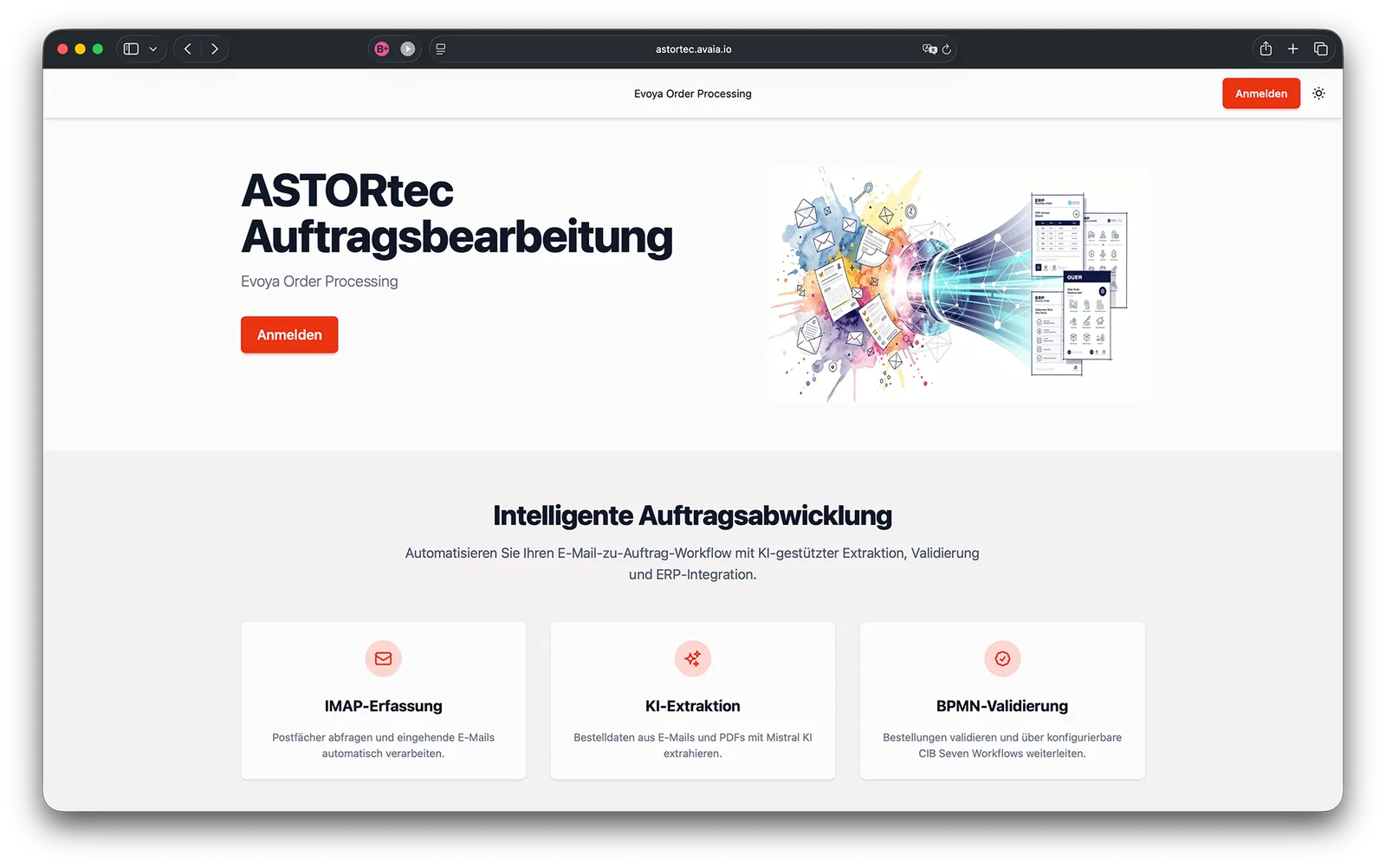
AI order capture at ASTORtec
Orders from e-mails and PDFs are captured, checked and transferred to the Europa3000 ERP automatically – 1–2 minutes per order instead of around 10.
View project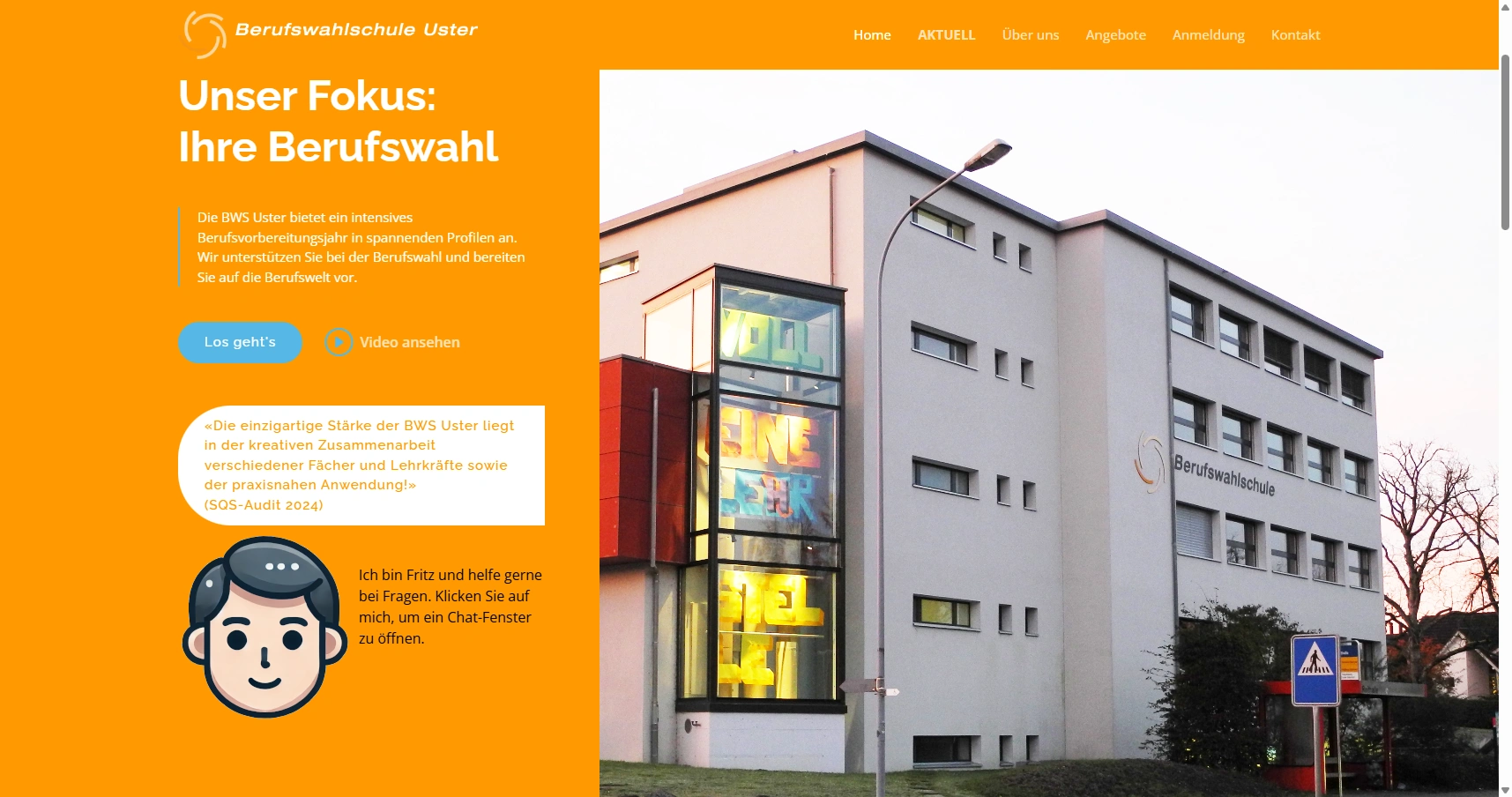
BWS Uster – AI agents and workspaces
AI workspaces, more than 30 custom AI agents and Active Directory integration for over 200 users.
View projectFrequently asked questions
Private AI refers to running language models in an environment an organisation controls itself, such as its own data centre or a dedicated private cloud. The data does not leave that environment and is not used to train third-party models. It is usually based on open-weight models such as Mistral, Llama, Qwen or Apertus.
Private AI makes sense when particularly sensitive data is processed, such as health data, client data under professional secrecy or trade secrets. It also pays off with high, steady request volumes or when independence from individual providers matters. For many other tasks, a carefully configured Swiss cloud solution is sufficient.
Yes. Open-weight models can run on your own GPU servers and be used via an internal interface. The hardware required depends on model size, number of users and the response time you need. Evoya AI clarifies these requirements in the project and sets up model servers, access rights and monitoring.
The largest commercial models are usually still stronger at complex tasks. For well-defined business tasks such as summarising, classifying, extracting or answering questions from internal documents, current open models often deliver good quality. That is why we test with your own sample data before you decide.
Yes. According to the Swiss Federal Data Protection and Information Commissioner (FDPIC), the current Data Protection Act applies directly to AI-based data processing. Private AI makes compliance easier because the processing location, access and retention are in your hands. Transparency towards data subjects and documented purposes are still required.
Professional secrecy under Art. 321 of the Swiss Criminal Code prohibits disclosing secrets entrusted to you, not the use of tools. With cloud services, however, contracts, access risks and the role of auxiliary persons must be checked carefully. If the model runs in your own network or in a controlled Swiss environment, the data does not leave the protected area.
The EU AI Act regulates AI systems by their purpose, not by where they run. It affects Swiss companies when they offer AI systems in the EU or when their output is used there. Private AI therefore does not change the obligations, but it makes documentation, logging and control easier.
We agree this depending on the operating model. Evoya AI can handle operation, monitoring and model updates or enable your IT team to do so. New model versions are tested against your use cases before deployment and rolled out in a controlled way.
Plan private AI for your organisation
Tell us about your use case and your data requirements. We will show you which operating model and which language model suit you.