
AI process automation: less manual work, more efficiency
Evoya AI automates your business processes with AI: orders, invoices, forms and e-mails are read, checked and transferred straight into your systems. Your team only reviews what genuinely needs attention.
What is AI process automation?
AI process automation is the automation of business processes using artificial intelligence. Unlike classic rule-based automation, it also handles unstructured information such as PDF documents, scanned forms, handwriting and free-text e-mails. The AI understands the content, extracts the relevant data and passes it to your systems in structured form.
Classic tools such as RPA or workflow platforms like Zapier, Make and n8n follow fixed rules: if A, then B. That works well as long as inputs always look the same. As soon as every order has a different layout, or customers describe their request in their own words, you need AI that understands content rather than matching positions.
Evoya AI, based in Uster in the Canton of Zurich, builds these automations as custom software with AI as an integral part. Processing runs in Swiss data centres by default, the processing location is selectable, and a control interface lets people review and approve the results.
What AI process automation delivers
Automation pays off wherever staff currently type, copy, sort or forward data. The AI takes on that work; your team makes the decisions.
Far less data entry time
Manual keying is largely eliminated. At ASTORtec, the effort per order fell from around 10 minutes to 1–2 minutes.
Handles unstructured documents
The AI reads PDFs, scans, handwriting and e-mails with varying layouts. No templates or fixed formats are required.
Fewer errors
Extracted data is automatically validated against master data and business rules. Discrepancies are flagged before they reach the ERP.
People stay in control
A control interface shows every case with its source and result. Your team reviews, corrects and approves.
Connected to your systems
The automation writes data directly into ERP, CRM, Microsoft 365 or specialist applications via APIs, MCP or file interfaces.
Your data under control
Hosted in Switzerland by default, compliant with the Swiss FADP and GDPR, with zero data retention and no training on your data.
Which processes can be automated with AI
The best candidates are processes that occur often, involve a lot of manual work and deal with documents, e-mails or data spread across several systems.
Order entry
Orders received by e-mail or as PDFs are read, matched against product and customer master data and created as orders in the ERP.
Invoice and document processing
Incoming invoices are recognised, fields such as amount, VAT and reference are extracted and prepared for approval. Payment release stays with a person.
E-mail triage and draft replies
Incoming e-mails are classified by request, routed to the right team and given a suggested reply.
Forms and handwriting
Completed forms, applications or tests are digitised, evaluated and exported, for example as an Excel file.
Data transfer between systems
Information is reconciled and transferred between ERP, CRM, SharePoint and specialist applications instead of being copied and retyped.
Reports and minutes
Conversations, notes or data are turned into structured reports that specialists only need to review and complete.
How we automate your processes
We start with one clearly defined process, measure the benefit and then expand.
-
1
Analyse the process
Together with your team we map the current workflow, volumes, time spent, exceptions and the systems involved.
-
2
Define the solution
We decide which steps can run on rules, where AI is needed and at which points a person reviews the result.
-
3
Prototype with real data
AI-assisted development produces a working prototype quickly, which we test with your real documents.
-
4
Integration and roll-out
The solution is connected to your ERP, e-mail and other systems, including a control interface and staff training.
-
5
Operation and development
We run the solution on our platform, monitor quality and exceptions, and extend it to further processes.
The building blocks behind the automation
We combine AI models with proven software engineering and choose the right technique for each step of the process.
Documents and language
- Text recognition (OCR) and handwriting recognition
- Data extraction with language models
- Classification of e-mails and documents
- Transcription incl. Swiss German
AI models and platform
- 30+ selectable language models
- OpenAI, Anthropic, Google, Mistral, Meta
- Swiss open-source models
- Evoya Agents with tools
Integration
- REST APIs and webhooks
- Model Context Protocol (MCP)
- Microsoft 365 and SharePoint
- ERP and CRM connectors
- Excel and file exports
Control and security
- Human-in-the-loop approvals
- Validation against master data
- Logging of every case
- Hosting in Switzerland, EU, USA or on-premise
Process automation from Switzerland
Software and AI from one team
We build custom software with AI as an integral part. AI-assisted development makes our projects noticeably faster than classic software projects.
Our own AI platform
Automations run on our platform with more than 30 language models, hosted by default in ISO 27001-certified Swiss data centres.
Data protection under FADP and GDPR
Zero data retention, no training on your inputs, and a processing location you choose, from Switzerland to on-premise.
Experience with Swiss companies
Our team brings more than 25 years of experience in software projects for Swiss companies, and we are based in Uster in the Canton of Zurich.
Selected projects
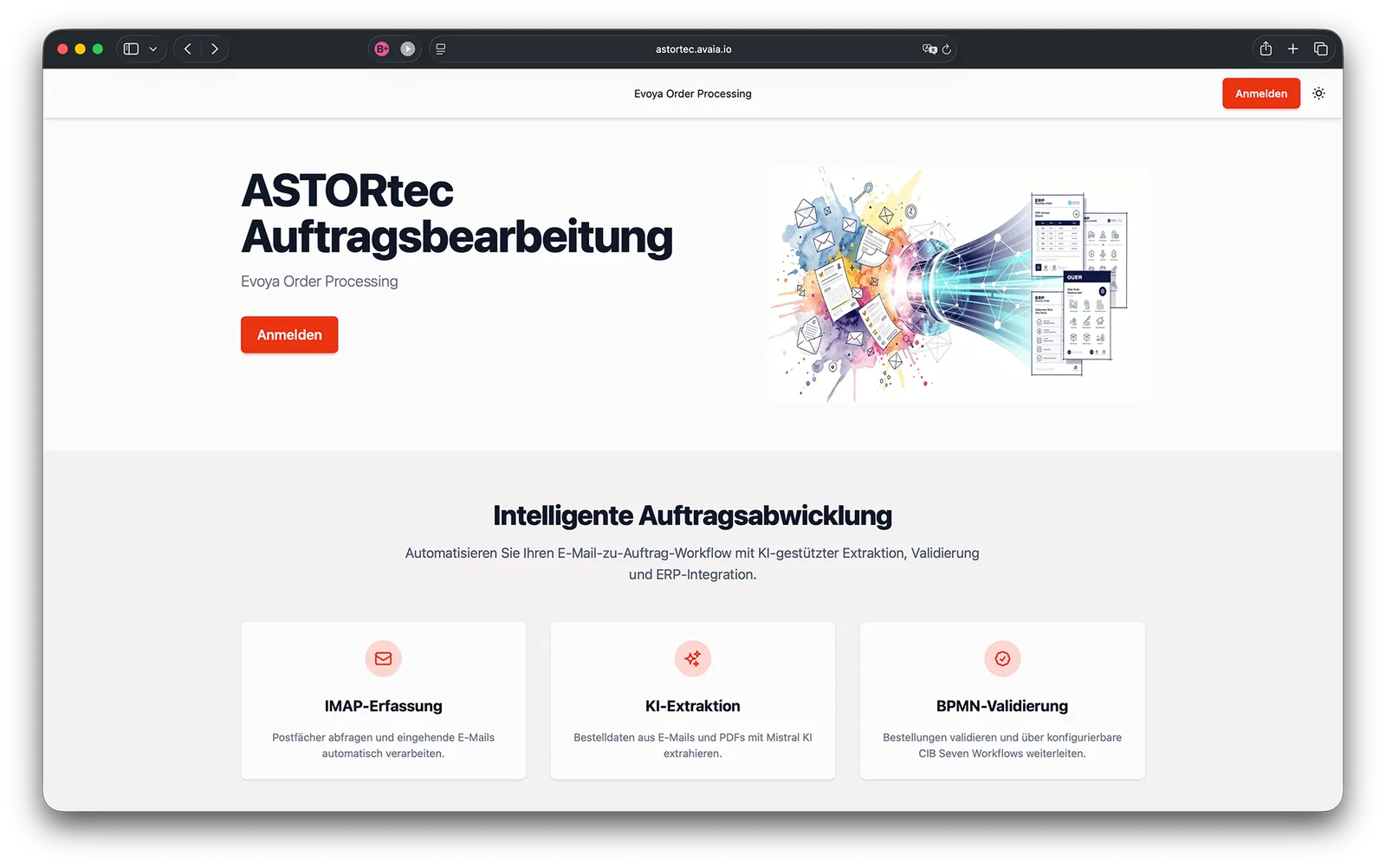
AI order capture at ASTORtec
Orders from e-mails and PDFs are captured, checked and transferred to the Europa3000 ERP automatically – 1–2 minutes per order instead of around 10.
View project
Griesshaber profile analysis – BWS Uster
Recognise handwriting, analyse it with AI and export to Excel – saving 30 to 60 minutes per test.
View project
IPW Winterthur – AI-powered conversation documentation
Record and transcribe patient conversations and generate reports automatically – with 100 % Swiss data processing, including Swiss German.
View projectFrequently asked questions
AI process automation is the automation of business processes using artificial intelligence. It also handles unstructured information such as PDF orders, invoices, forms and e-mails, extracts the relevant data and transfers it into your systems. People review and approve wherever it is needed.
RPA and workflow tools such as Zapier, Make or n8n are rule-based and suit uniform, structured workflows, such as forwarding a form submission. AI automation understands content and copes with varying layouts, free text and exceptions. In practice we combine both: rules for fixed steps, AI for documents and language.
Good candidates are processes that occur frequently, require a lot of manual data entry and involve documents or e-mails. Typical examples are order entry, incoming invoices, e-mail triage, form evaluation and data transfer between ERP, CRM and Microsoft 365. Rare one-off cases that are decided differently every time are less suitable.
That depends on the volume and the process. With AI order capture for ASTORtec, the manual effort per order fell from around 10 minutes to 1–2 minutes. For the AI profile analysis at the vocational school BWS Uster, automation saves 30–60 minutes per test.
Yes. By default, processing takes place in ISO 27001-certified data centres in Switzerland. The EU, the USA or on-premise operation are also available on request. The platform complies with the Swiss FADP and the GDPR, inputs are not retained and are never used to train models.
Only as far as you decide. We build in review steps where staff see results in a control interface, correct them and approve them. According to Gartner, over 40 per cent of agentic AI projects will be cancelled by the end of 2027, partly because of inadequate risk controls – which is why we design in human control from the start.
No. The automation connects to your existing systems, such as ERP, CRM, e-mail inboxes or Microsoft 365. At ASTORtec, orders are transferred directly into the existing Europa3000 ERP.
The cost depends on the process, the data sources and the systems to be connected. In an initial conversation we therefore clarify volumes, time spent and goals, and show you where automation pays off. Thanks to AI-assisted development, our projects are delivered noticeably faster than classic software projects.
Which process would you like to automate?
Tell us about a workflow that still takes a lot of manual effort. We will show you how AI can take it over – with your data under control.