
AI Order Capture at ASTORtec: PDF orders transferred automatically to the ERP
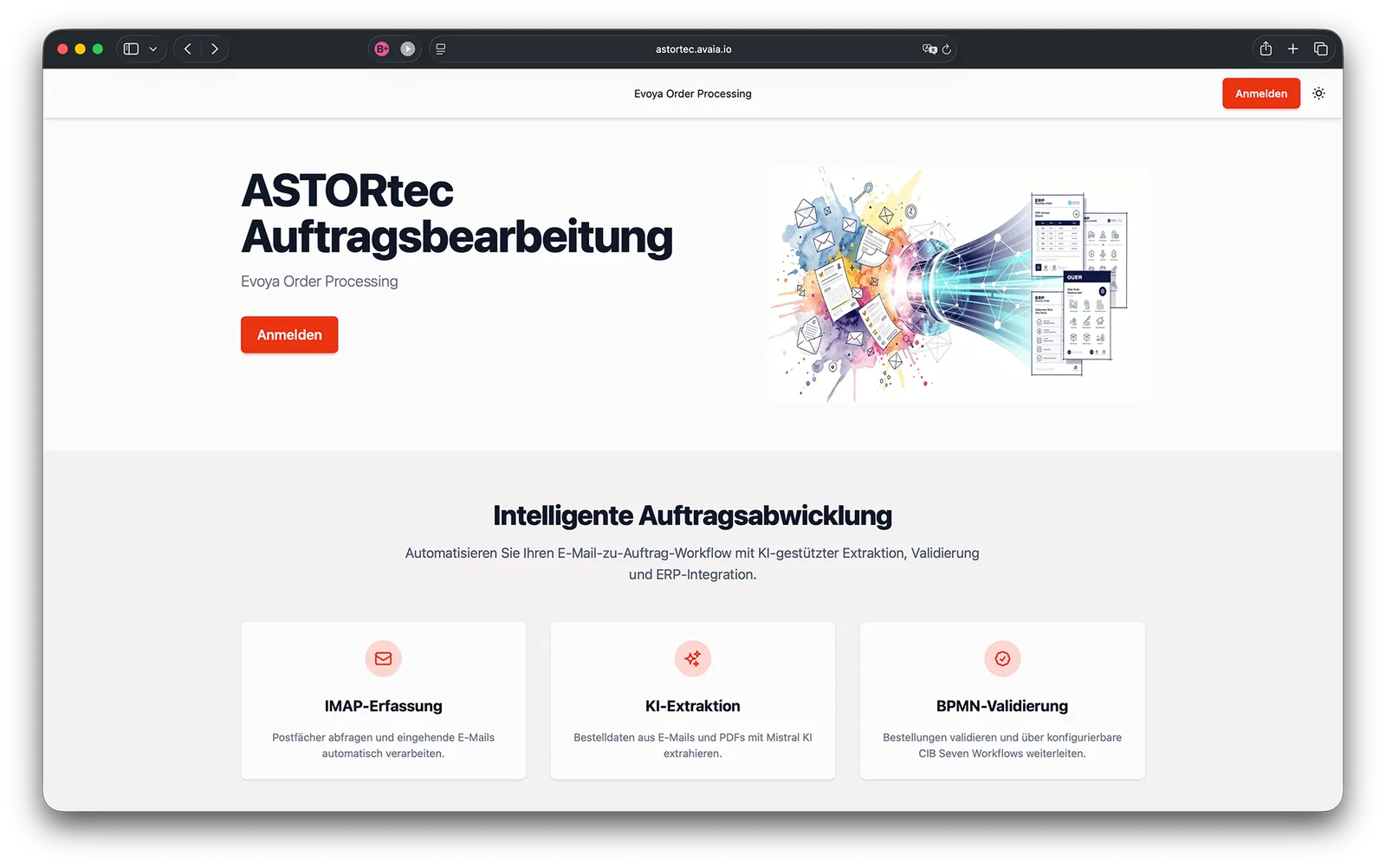
ASTORtec · Project overview ·
The project at a glance
Evoya AI has developed an AI-powered order capture solution for ASTORtec. The Evoya Order App reads PDF orders from emails, structures and validates the order data and transfers it to the ERP system Europa3000 as soon as all rules are met.
Orders that previously required an average of around ten minutes of manual entry are now processed automatically or checked and approved in one to two minutes.
- Client
- ASTORtec AG
- Industry
- Technical trade and industrial supplies
- Use case
- Automatic capture of B2B orders from PDF attachments
- Solution
- Evoya Order App
- Integration
- Europa3000
- Technologies
- Python, Django, Mistral OCR and, among others, Mistral LLM
Impressions from the project
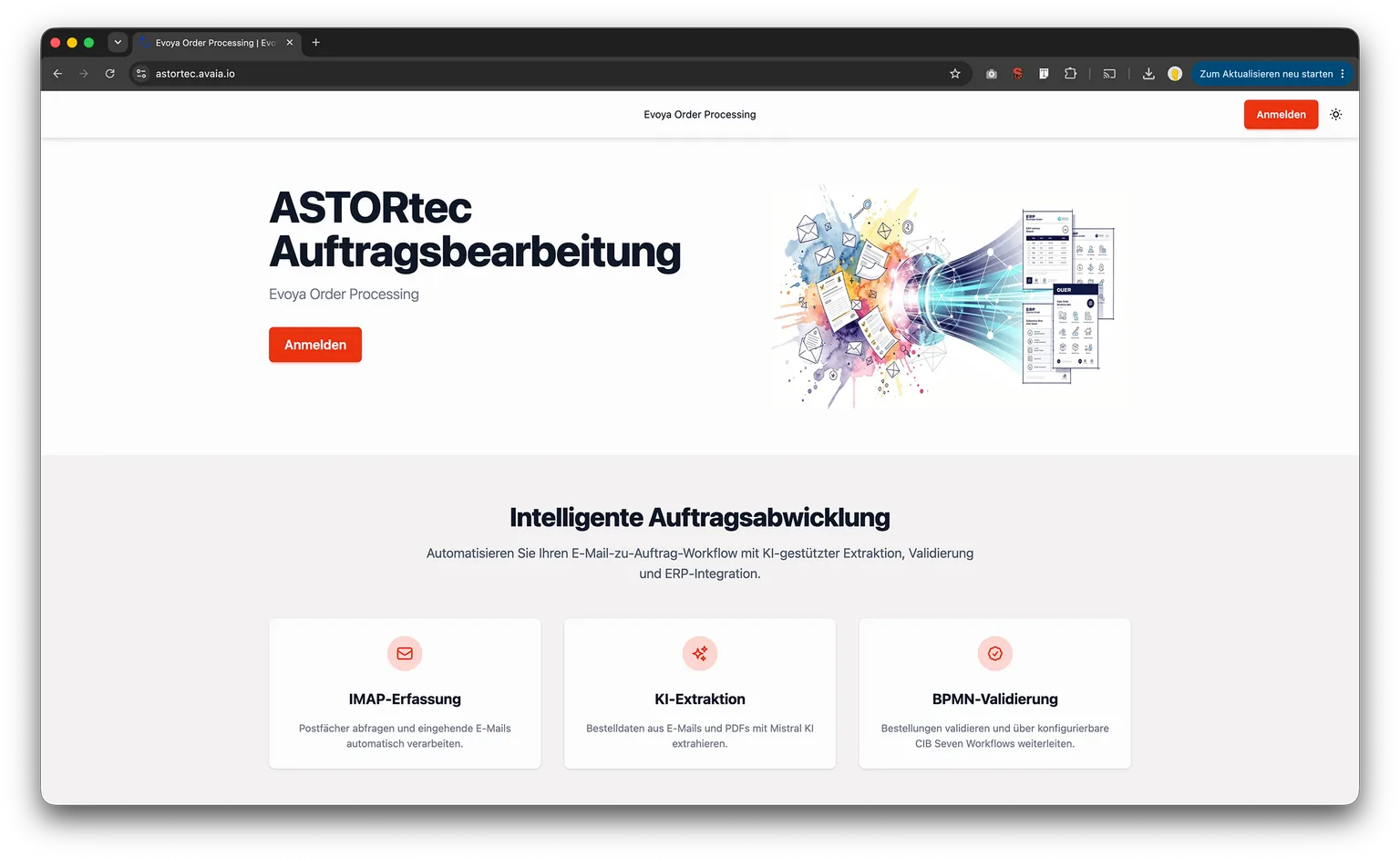
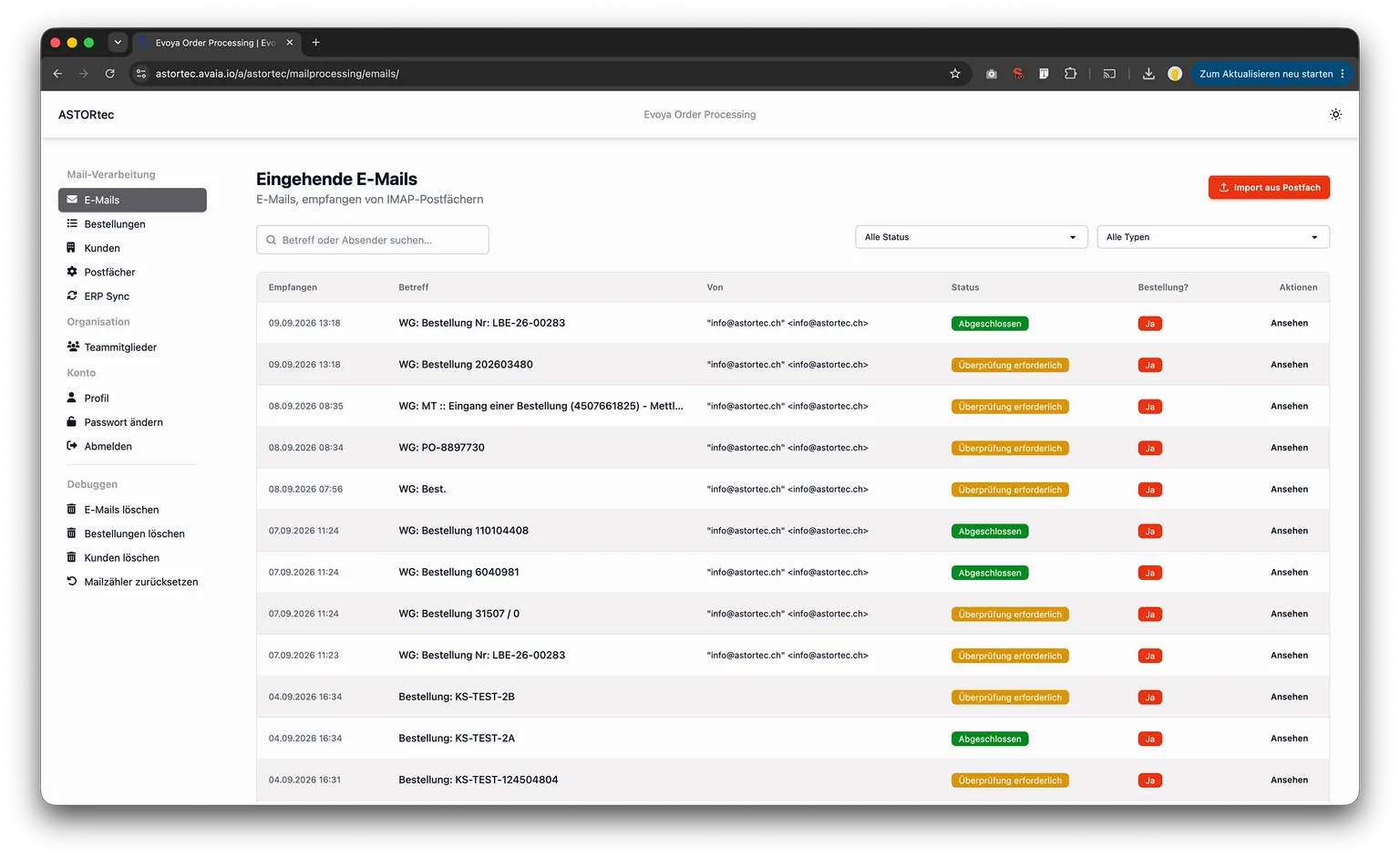
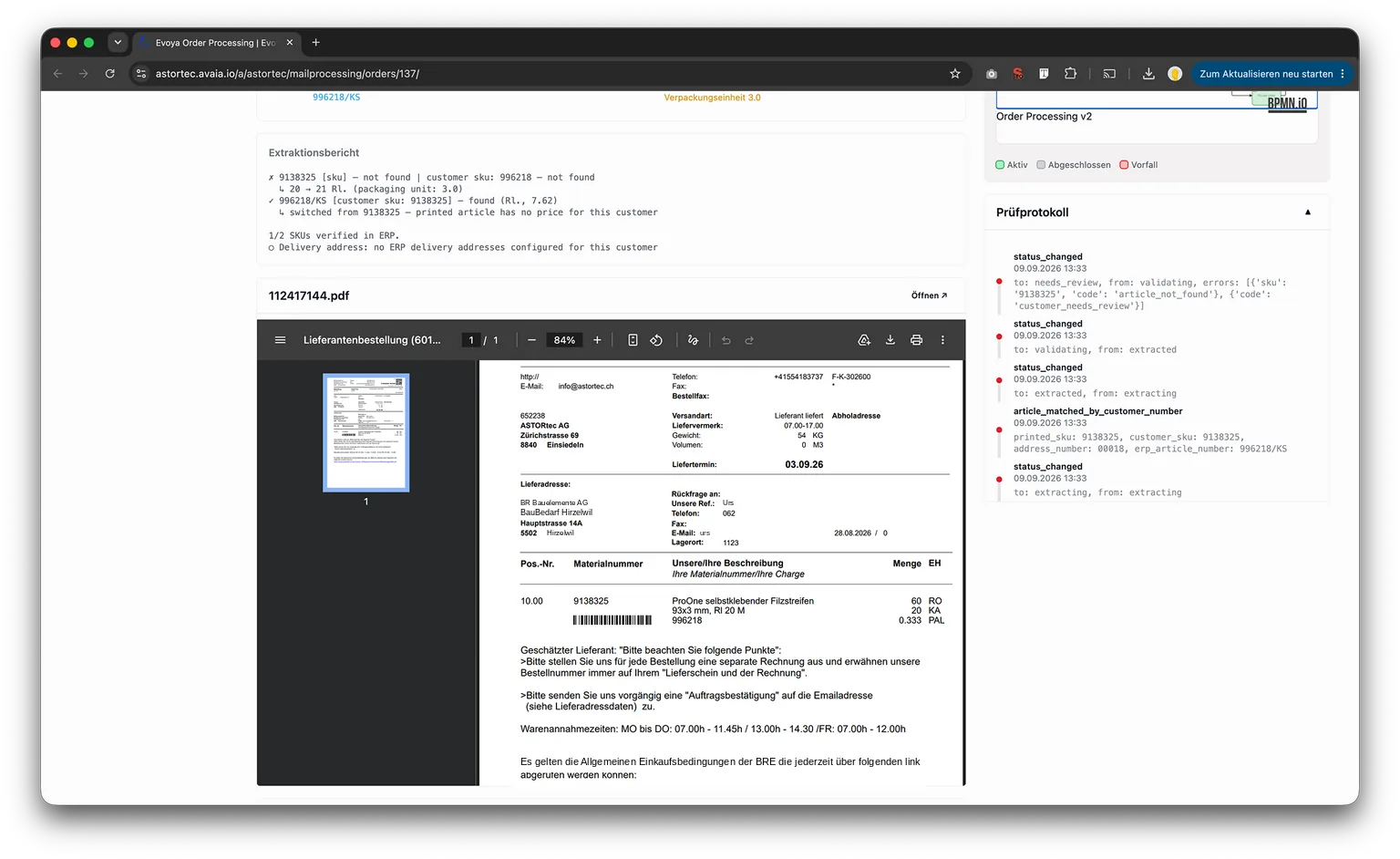
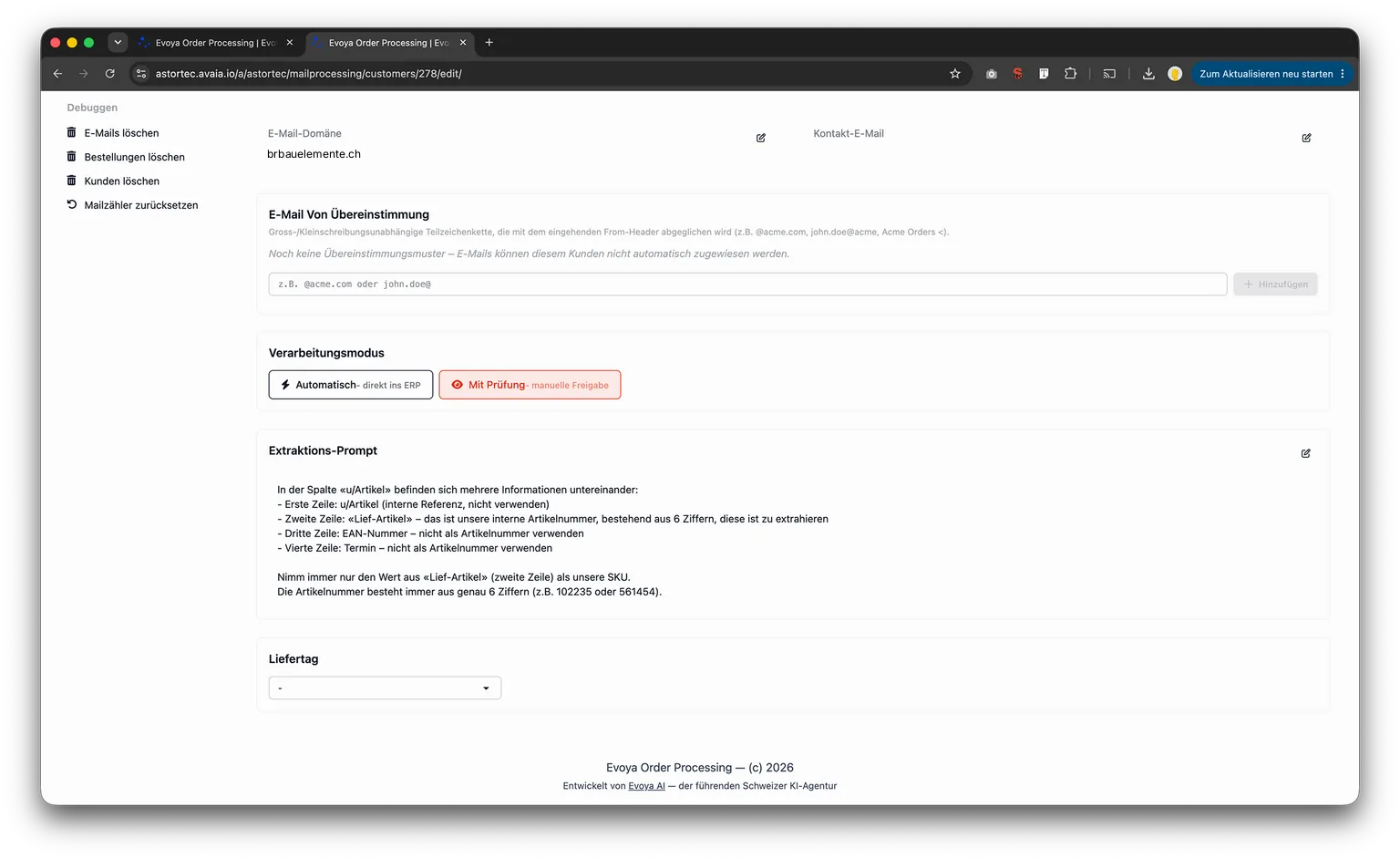
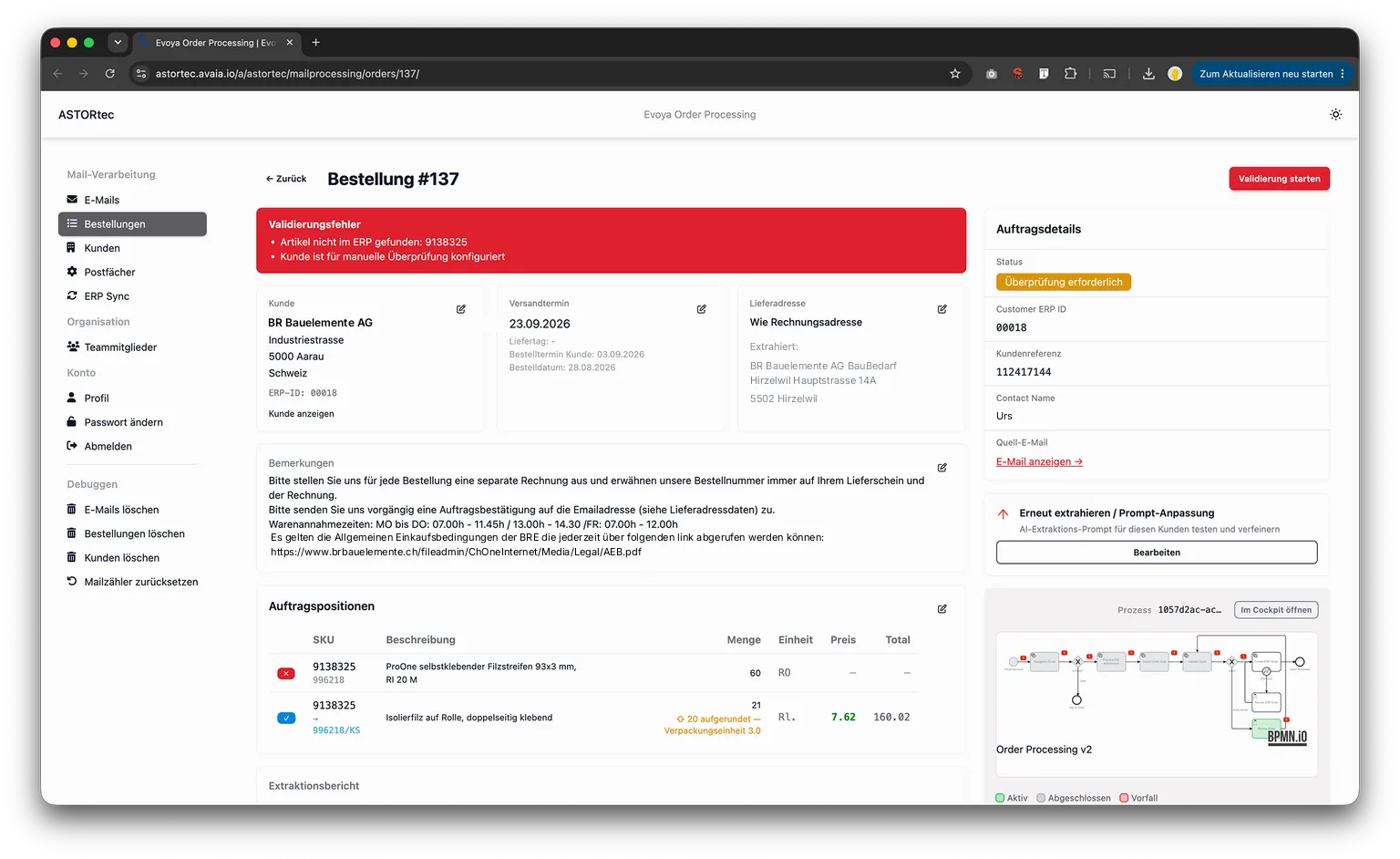
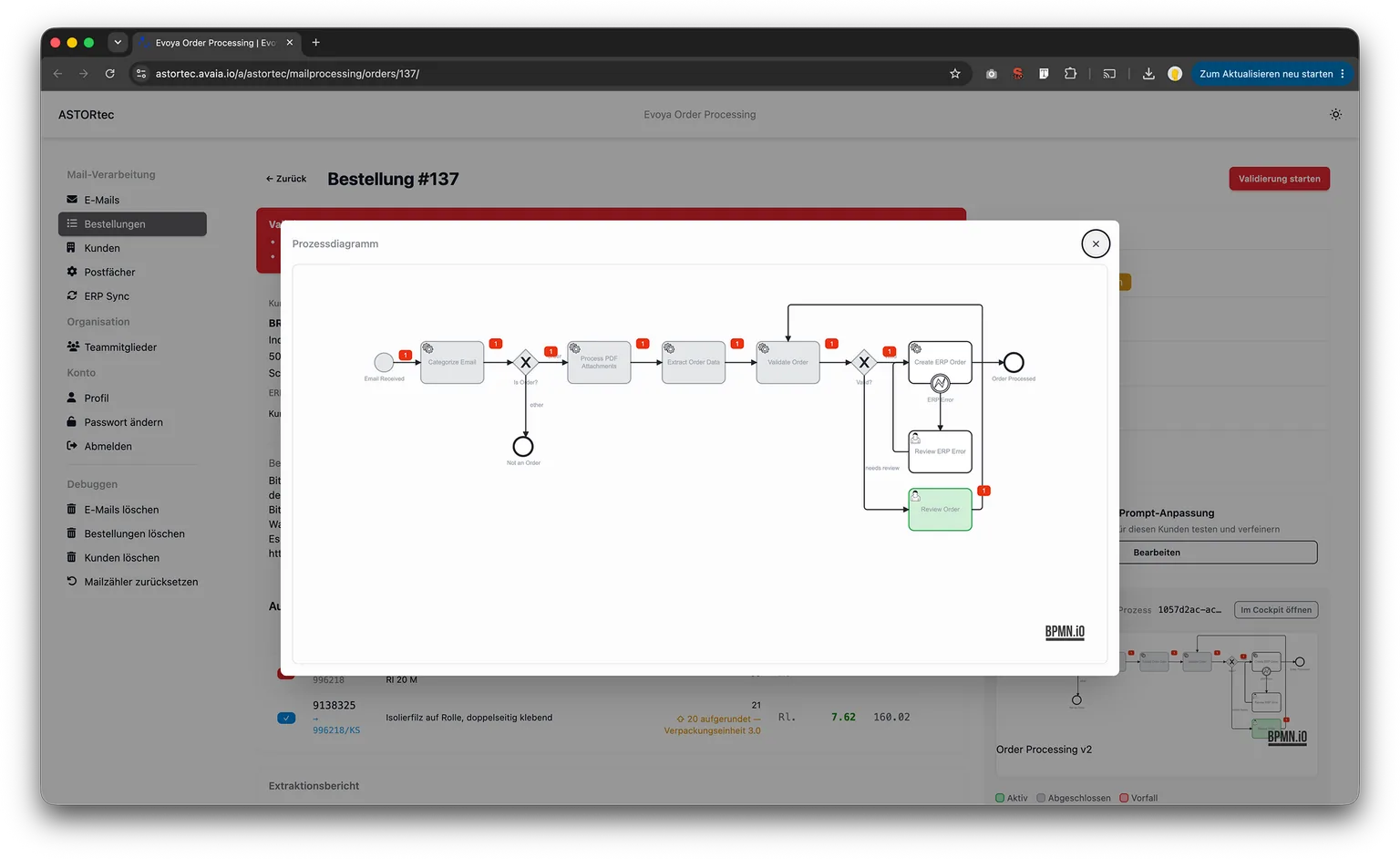
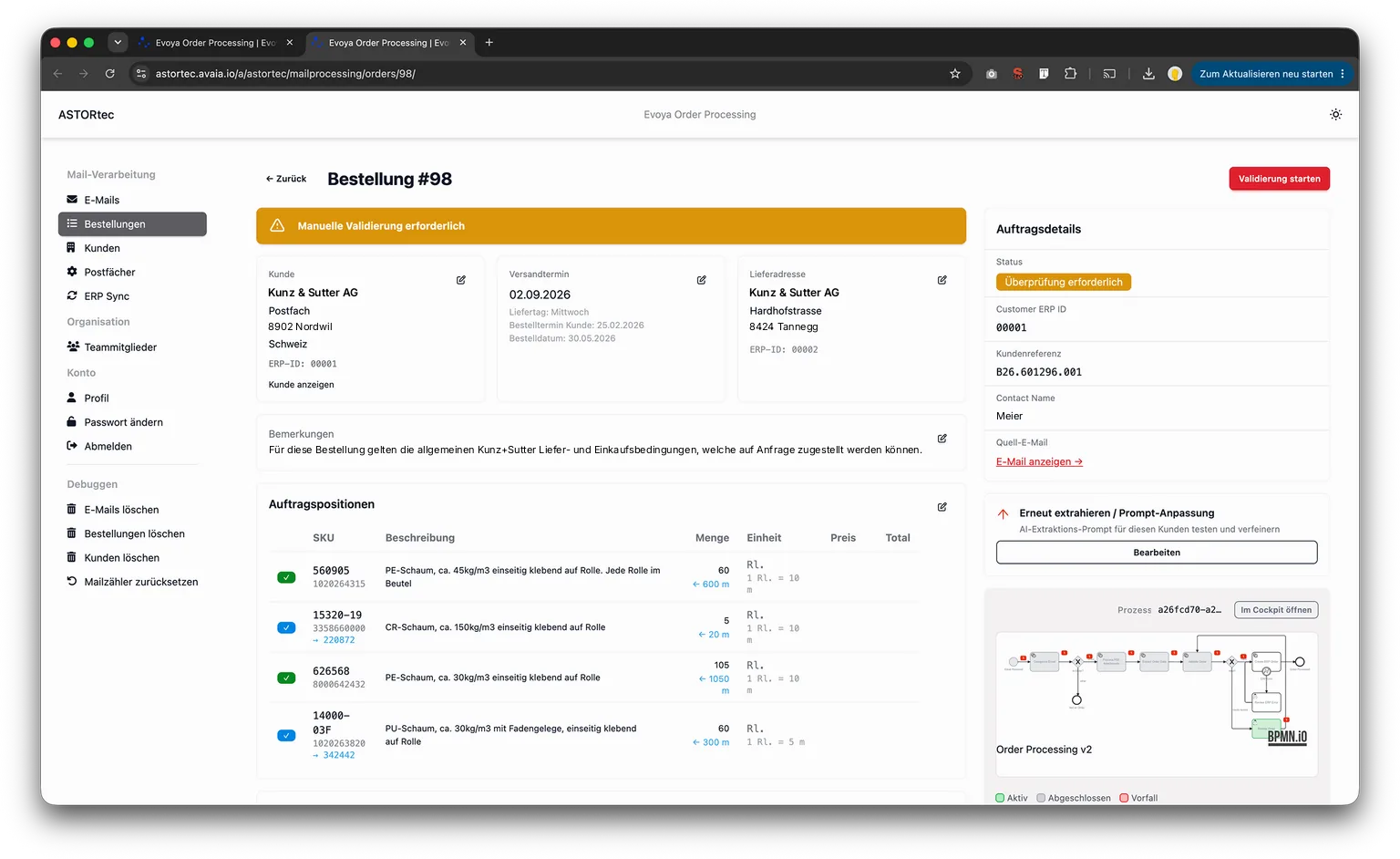
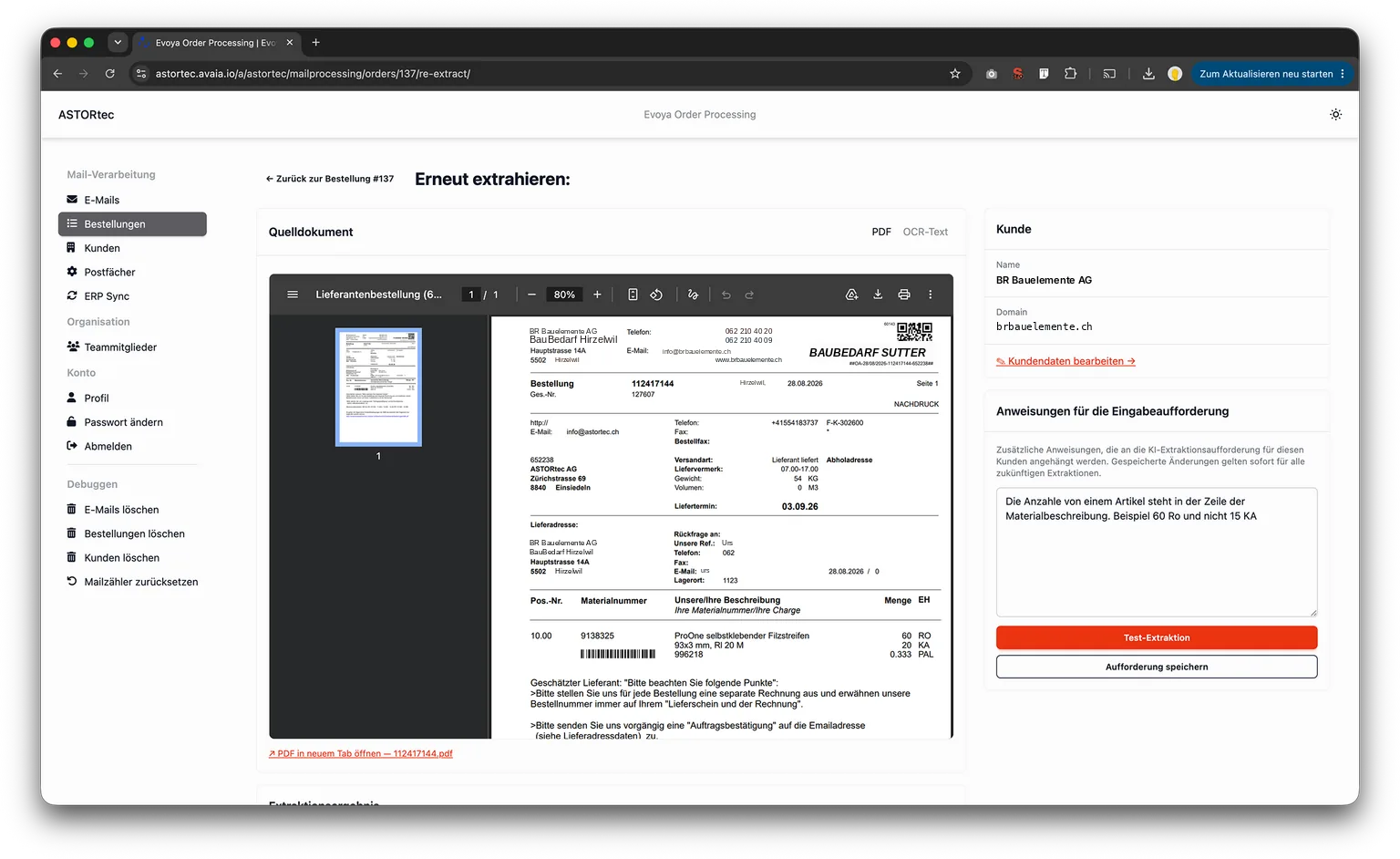
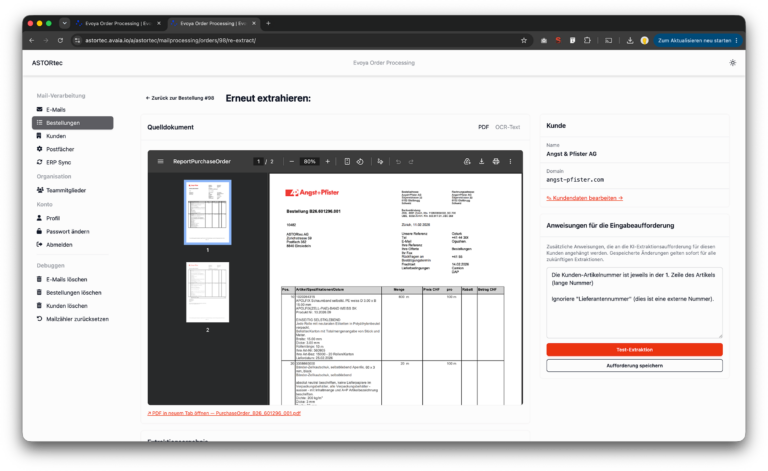
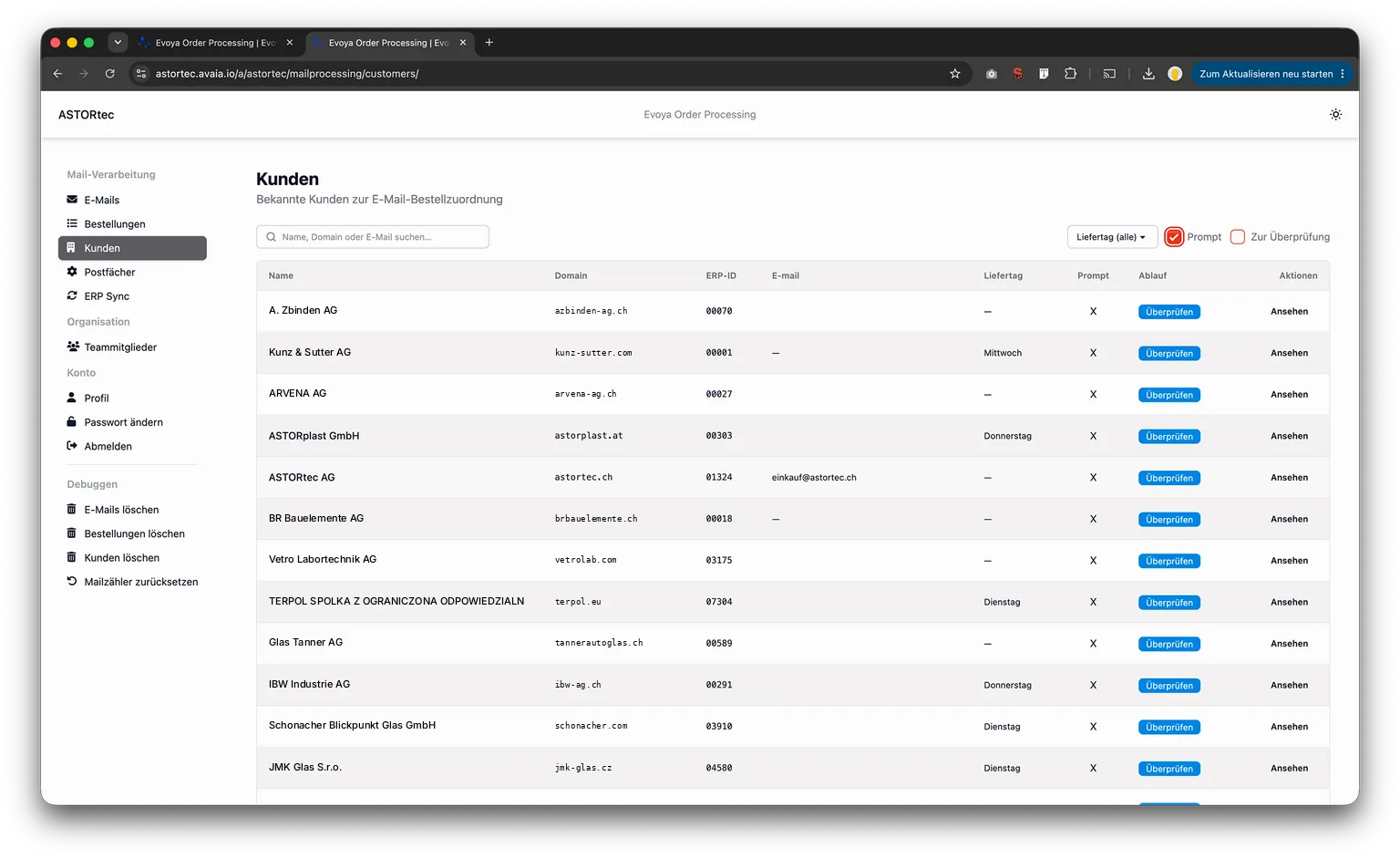
Initial situation: every PDF order looks different
ASTORtec supplies companies from industry and construction with adhesives, seals, rolled materials, stamped parts and other technical products. Many B2B orders arrive by email as PDF attachments – frequently generated automatically from the customers’ ordering systems.
These documents differ considerably. Individual article numbers, differing quantity and packaging units, delivery dates and subsequent corrections must be recognised and assigned correctly.
Until now, employees checked each order manually and transferred it to the ERP. This took an average of around ten minutes per order – considerably longer for extensive PDFs. In addition, there was a risk of transfer errors.
Goal: less manual entry, targeted control for exceptions
The solution was to make differently structured orders usable for automatic processing. The focus was on:
- Reduce entry work: adopt order data from PDFs instead of typing it in.
- Standardise and check data: take customer formats and special order logic into account.
- Connect Europa3000: continue processing checked data directly in the existing ERP.
- Retain control: specifically hold back orders with deviations or missing information for review.
The solution: from order email to checked ERP order
The Evoya Order App combines AI-powered document processing with fixed business rules and an ERP integration. The process comprises four steps.
1. Detect orders and read PDFs: Incoming order emails are forwarded to the application. It first checks whether an actual order is present. Mistral OCR then reads the PDF attachments. Document recognition captures text as well as table and line item data and prepares it for further processing.
2. Interpret and structure order data with AI: Language models interpret the extracted information and bring it into a uniform structure. Customer-specific prompts provide additional guidance on how particular order formats should be read. This allows the application to handle individual article numbers, differing designations and special order logic. The AI therefore does more than plain text recognition: it classifies the content for the subsequent business process.
3. Validate data and hand it over to Europa3000: Defined validation rules apply before the ERP transfer. They check, among other things, quantities and packaging units, delivery dates, article assignments and further customer-specific criteria. If all criteria are met and automatic processing is enabled for the customer in question, the application creates the order directly in Europa3000.
4. Hold back unclear cases for manual review: In case of deviations or missing information, the order remains in the Evoya Order App. Employees can review, correct and approve the data via the web interface. This eliminates full manual entry while control over exceptions is retained. AI interprets the documents; fixed rules and human approvals control further processing.
Data privacy and sovereignty: Mistral on EU infrastructure
Orders contain confidential business information and may include personal data. That is why the question of where and how the AI processes data is part of designing the solution.
For ASTORtec, Evoya AI uses Mistral on sovereign EU infrastructure. The processing location of the AI is thus deliberately chosen as part of the architecture. For comparable projects, Evoya AI offers further operating models:
| Sovereign EU infrastructure | Used at ASTORtec for AI processing with Mistral |
| Swiss solutions | Alternative for projects with requirements for AI processing and data storage in Switzerland |
| On-premises | Alternative for operation within the company’s own infrastructure |
The choice depends on the customer’s requirements. Beyond the location, access rights, retention, involved service providers and contractual arrangements must also be considered. This way, data privacy is not reduced to a hosting label but is assessed in the concrete data flow.
For more information, see Security and privacy at Evoya AI and On-premises AI solutions.
Results: less entry work in day-to-day business
Orders that previously required an average of around ten minutes of manual entry are now either processed automatically or checked and approved in one to two minutes. These figures refer to the manual processing effort, not to the total technical throughput time.
This gives ASTORtec concrete benefits:
- Less data entry: employees no longer have to type in order data in full.
- Targeted handling of exceptions: attention is mainly required for orders with deviations or missing details.
- Fewer transfer errors: manual transfer of article numbers, quantities, prices and delivery dates is reduced.
- Continued use of the existing ERP: Europa3000 remains in use and is extended with AI-powered processing and a web interface.
Transferability: automating further PDF processes with AI
The approach is not limited to orders. Wherever information from incoming PDFs is read, checked and transferred to a business system, a comparable AI solution can be applied. The basic principle remains the same: receive documents, extract and structure content, apply business rules and pass checked data on to the next process.
Possible further use cases are:
| Orders | Capture articles, quantities and delivery dates for order creation |
| Delivery notes | Read delivery line items and provide them for matching with orders |
| Invoices | Pass invoice data and line items to review and approval processes |
| Quotations | Structure quotation data for comparison or further processing |
| Forms | Extract details and feed them into downstream business processes |
These applications describe the potential of the approach beyond the ASTORtec project. Evoya AI adapts document processing, validation rules and approvals to the respective process.
ERP integration beyond Europa3000
A comparable solution can also be connected to other ERP systems, provided suitable interfaces are available. These include, for example, SAP S/4HANA, Microsoft Dynamics 365 Business Central, Abacus, Sage and Odoo. The integration is tailored to the specific system, its version and the required functions. It is not just about transferring data: the integration must enable the actions required by the process, such as creating an order.
For companies in Switzerland, Germany and Austria, this opens up a practical way to keep using existing systems while reducing manual work in between. A clearly delimited document process can serve as an entry point and later be extended with further use cases. More about this approach: Custom AI applications from Evoya AI.
Frequently asked questions about AI-powered order capture
At ASTORtec, the Evoya Order App reads PDF orders from emails. AI structures the content, then defined rules check the order data. If all requirements are met and automatic processing is enabled, the order is created in Europa3000.
Yes. At ASTORtec, customer-specific prompts help interpret different order formats, individual article numbers and special order logic. Validation rules check the structured data before further processing.
The order remains in the Evoya Order App for manual review. Employees check and correct the details and then approve them. The automatic ERP transfer only takes place when the defined conditions are met.
Previously, entry took an average of around ten minutes per order. Today, orders are processed automatically or checked and approved in one to two minutes. The comparison refers to manual processing time.
At ASTORtec, AI processing runs with Mistral on sovereign EU infrastructure. For other customer projects, Evoya AI can provide Swiss solutions or on-premises operation. Beyond the location, the concrete data flows, access rights and contractual conditions are decisive.
Yes. Evoya AI can implement comparable solutions with Swiss AI and hosting solutions or for the company’s own infrastructure. Models and components are selected to match the requirements. These operating variants are alternatives to the EU infrastructure used at ASTORtec.
Basically yes, provided suitable interfaces are available for the desired process. Sage and Odoo are also possible target systems. Evoya AI assesses the integration options and implements the appropriate connection. At ASTORtec, the connection to Europa3000 has been realised.
Yes. The approach can be transferred to further document processes. AI reads and structures the content, rules check the details, and an integration passes the data to the target system. Evoya AI aligns the process with the respective document type and business process.
Automate PDF processes – with the right integration and data setup
Document processing, ERP integration and operating environment are tailored to your specific needs – with EU infrastructure, Swiss solutions or on-premises.